
shutterstock_2591836165-600x373

Enabling Finance-Driven Digital Transformation with Agentic AI-Powered Automation

Industries today are rapidly relying on intelligent automation systems that independently handle tasks, make decisions, and adapt to any change in situation. AI-driven agents are designed to minimize workloads by managing anything from day-to-day operations like data entry to more complex activities like real-time data analysis. These agents are steadily becoming integral to modern operations, enhancing productivity to focus on more strategic priorities. . According to Gartner, by 2029, agentic AI will autonomously resolve around 80% of common customer service issues without human intervention, leading to a 30% reduction in operational costs. Many enterprises have already discovered the power and efficiency of automation. Now, they can unlock the full value it offers to the finance function. According to a McKinsey survey, the share of finance functions adopting automation and artificial intelligence has more than tripled. Automation offers elevated productivity, enhanced user & customer experience, and guards against team burnout

How Do AI Agents Work?

Agentic AI combines perception, reasoning, and action to interact with its data environment and achieve defined goals autonomously. It can handle repetitive manual tasks and operates through a structured workflow involving several core components.

  1. User provides instructions: The user promptly interacts with the AI system using natural language. The AI system then identifies the intended action and can request additional information from the user if necessary.
  2. Agent system plans, sorts, and executes work: The agent system gets input into the specific workflow through prompts and process prompts. Manager subagents assign tasks or subtasks to specialized agents.
  3. The agent system iteratively improves output: Throughout the process, the agent may request additional information from the user to ensure greater accuracy and relevance.

Agent execution: The agent can execute any action to complete the user-requested task.
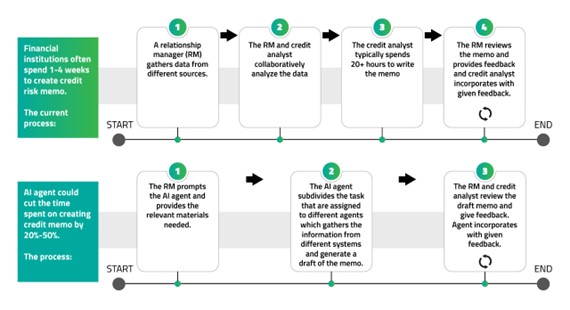
AI Agents have the potential to change the way we work by supercharging productivity:
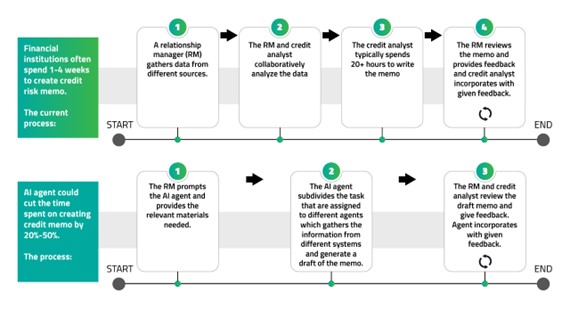
High-level Use Case: Credit risk memos
Key Benefits of AI Agents in Finance Industry:
 
  • Automation: AI agents can enhance automation by streamlining complex financial processes, reducing manual efforts, and improving operational efficiency.
  • Save on costs: AI agents can reduce operational expenses by removing costly and inefficient processes and manual work.
  • Break down silos: A network of interconnected, collaborative agents can reduce common obstacles that emerge from complex projects by streamlining data collection and workflows across different departments.
  • Scale to changing needs: AI agents can easily adopt complex processes and a high volume of tasks, letting companies expand their operations without sacrificing efficiency.

UXUI-Designer

How UX Design Can Enable Business Success

The effectiveness of UX Design is determined by the ability to understand users and their pain points and address them through an iterative design process. A designer would already know this. For others, this blog aims to outline the role of UX design in influencing business decisions and strategies. The key question: Is UX assessed for its impact on the business? A thoughtfully designed UX can influence a user’s decision to buy a product and impact business growth. The core idea here is that UX design outcomes are directly proportional to business outcomes. Is it getting discussed as a critical business strategy?

UX design makes interfaces look visually rich and engaging. However, the role of UX design goes far beyond visual appeal and can be pivotal in shaping adoption, increasing engagement, and fostering brand loyalty. It is a strategic element closely tied to business outcomes and is measured accordingly by establishing criteria linked to business success. There are multiple real-world examples where UX has played the role, especially when design becomes integral to business strategy and outcomes are closely measured. For example, NPS score, user behaviour analytics, and adoption rate are all important metrics to be looked at. From our perspective, this shift is crucial for making design more involved and linked to business growth.

Today, businesses work hard to create products that solve real problems and exceed customer expectations. The question is: How easy is it to turn an idea into a product that customers are willing to pay for? In an experience-driven economy, customers now expect seamless, intuitive, and engaging interactions. Businesses realize that user experience is a key differentiator for a product’s success, but often don’t see it receiving the required strategic attention. The relevance of UX design from the ashes of what is typically called “look and feel”. It has evolved from being a “nice-to-have” to a business essential. There is a need to bridge the gap by making it a critical business strategy that directly impacts growth, retention, and revenue. Here are a few aspects of UX design that stand out as key differentiators and essential drivers for business growth.

  1. Serve as a Key Differentiator
  • Businesses such as Apple, Airbnb, and Tesla made UX their key differentiator.
  • The crafted experiences can win customers’ trust at the outset, increase engagement, and ultimately enhance customer satisfaction.
  • Example: Redesigning Airbnb’s booking process led to a 30% increase in conversion rates.
  1. Increases Efficiency
  • Cycling through design iterations at early stages in the product lifecycle helps minimize development costs and avoids expensive rework.
  • Research from IBM suggests that every $1 invested in UX returns $100 in ROI.
  1. Increases Conversion & Retention
  • A well-designed experience optimizes task flows, which eventually improves user engagement.
  • A frictionless experience builds trust, leading to higher customer retention.
  • Example: Amazon’s one-click checkout simplifies the buying process, reduces cart abandonment, and boosts sales.
  1. Outcome-Driven Decision Making
  • Leveraging user data to effectively gain insight into customer behaviour, which is key to making outcome-driven decisions.
  • Data-driven insights lead to continuous improvement and enhance the user journey.
  • Example: Netflix’s personalized recommendations use UX research to increase user engagement and retention.
  1. Builds Brand Perception & Customer Loyalty
  • A brand’s reputation is largely shaped by the experience it provides to its customers.
  • Consistency in UX across touchpoints strengthens a brand’s identity.
  • Example: Google’s minimal, fast-loading interface has kept users loyal for decades.
  1. Propels Growth
  • A designer can influence product strategy by empathizing with users’ needs effectively and creating an alignment with business objectives.
  • Investment in UX isn’t just about usability and business scalability.
  • Example: Spotify’s user-centred design approach has driven global adoption.
 Conclusion

 In summary, a rich, personalized, and engaging customer experience can go a long way in directly influencing business outcomes, for better or worse. As attention spans shrink, patience levels dwindle, and customer expectations rise, it becomes imperative for a business to create seamless and tailored experiences at scale. This requires proactive integration of design principles in the initial stage and making UX design a critical part of the business strategy.